
Dashboard
Dashboard
Systems
By HiGroPonics Team · Updated June 2026
There is no single best hydroponic system — only the best system for your space, budget, crops, and how much attention you want to give it. Each method has a different approach to delivering water and nutrients to roots, and that fundamental difference shapes everything else: cost, complexity, maintenance, and which plants thrive in it.
This guide covers every major system type with honest pros and cons, so you can make a confident choice before spending money on equipment.
Foundations
Understanding these core principles will help you choose the right system for your goals, space, and budget.
Recirculating (Closed-Loop)
The nutrient solution is pumped to the plants, and any excess runoff drains back into the same reservoir to be reused. Examples: DWC, NFT, Ebb & Flow.
Pro
Highly efficient use of water and nutrients.
Con
pH/EC levels can fluctuate. Water-borne diseases can spread rapidly.
Non-Recirculating (Run-to-Waste)
Nutrient solution is delivered to the plants, and excess runoff is discarded rather than reused. Examples: Kratky, some drip configurations.
Pro
Plants always receive a fresh, balanced solution. Less risk of spreading root diseases.
Con
Wasteful of water and nutrients, making it more expensive to operate.
Active Systems
Use pumps to move the nutrient solution or provide oxygen. Examples: DWC, NFT, and Ebb & Flow.
Pro
Faster growth and higher yields due to superior nutrient delivery and oxygenation.
Con
Relies on electricity. A pump or timer failure can be catastrophic if not addressed quickly.
Passive Systems
Have no moving parts and rely on gravity or wicking action to deliver nutrients. Examples: Kratky method and Wick systems.
Pro
Extremely simple, low-cost, and silent. Not dependent on electricity.
Con
Slower growth rates. Less suitable for large plants with high water and nutrient demands.
Small Plants & Leafy Greens
Systems like Kratky, DWC, and NFT are ideal for lightweight, fast-growing plants like lettuce, herbs, and spinach.
Large & Fruiting Plants
Systems like Dutch Buckets, Drip, and Ebb & Flow are better for larger, heavy-feeding plants like tomatoes, cucumbers, and peppers.
At a Glance
| System | Difficulty | Water Use | Best Crops | Pump Required? |
|---|---|---|---|---|
| DWC | Beginner | Low | Lettuce, herbs | Air pump only |
| Raft DWC | Beginner | Low | Lettuce at scale | Air pump only |
| Kratky | Beginner | Very low | Lettuce, herbs | None (passive) |
| NFT | Beginner–Intermediate | Low | Leafy greens, herbs | Yes |
| Ebb & Flood | Intermediate | Medium | Most crops | Yes + timer |
| Drip | Intermediate | Medium–High | Fruiting crops | Yes + timer |
| Dutch Bucket | Intermediate | Medium | Tomatoes, cucumbers | Yes + timer |
| Aeroponics | Advanced | Very low | Fast-root crops, cloning | High-pressure pump |
| Wick | Beginner | Low | Small herbs only | None (passive) |
| Drip Tower | Beginner–Intermediate | Low | Herbs, leafy greens | Submersible pump |
| Aeroponic Tower | Intermediate–Advanced | Very low | Herbs, leafy greens | High-pressure pump |
| Stacked NFT Rack | Intermediate | Low | Lettuce at scale | Yes + timer |
| Pocket Wall | Beginner–Intermediate | Low | Herbs, strawberries | Submersible pump |
The Systems
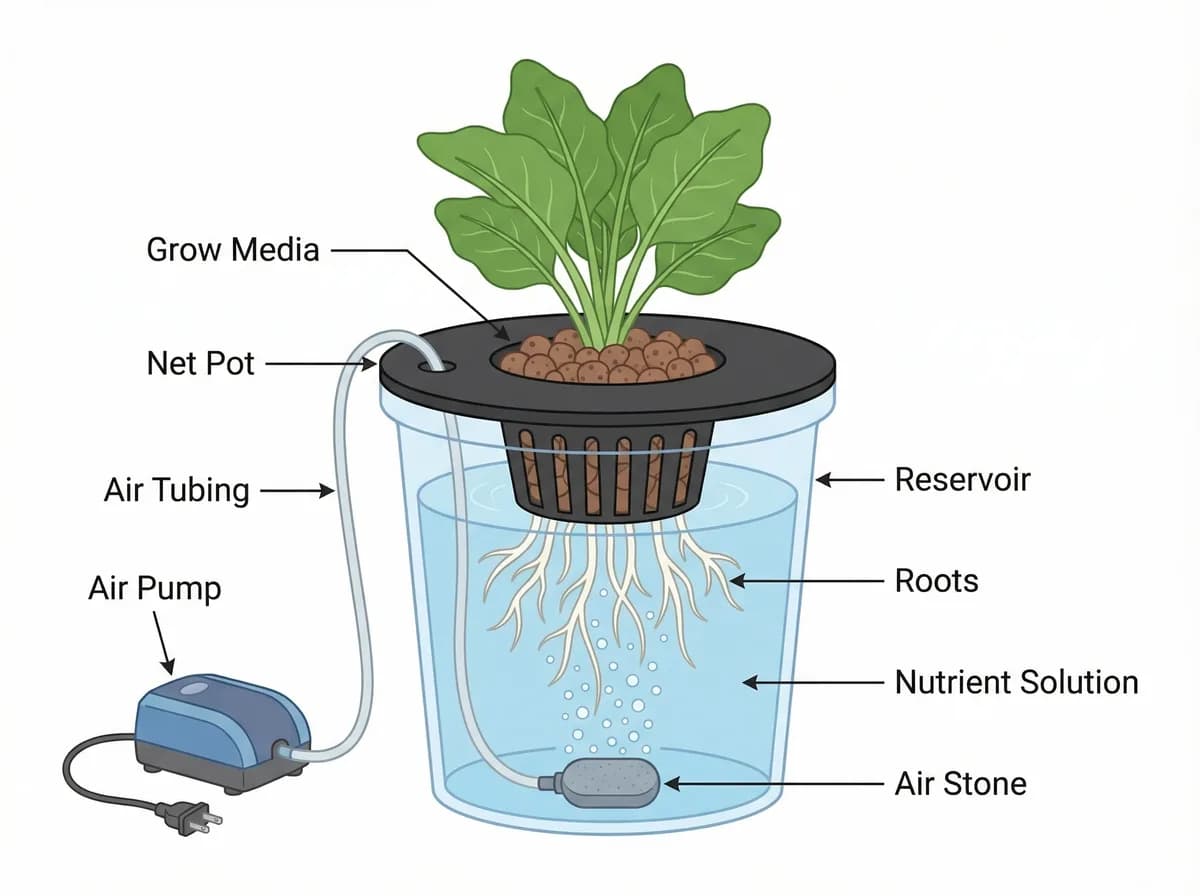
Best for: Lettuce, herbs, leafy greens
Plants sit in net pots above a reservoir of oxygenated nutrient solution, with roots submerged directly in the water. An air pump and air stone keep dissolved oxygen high and prevent root rot. One of the simplest active systems to build and maintain.
Pros
Cons
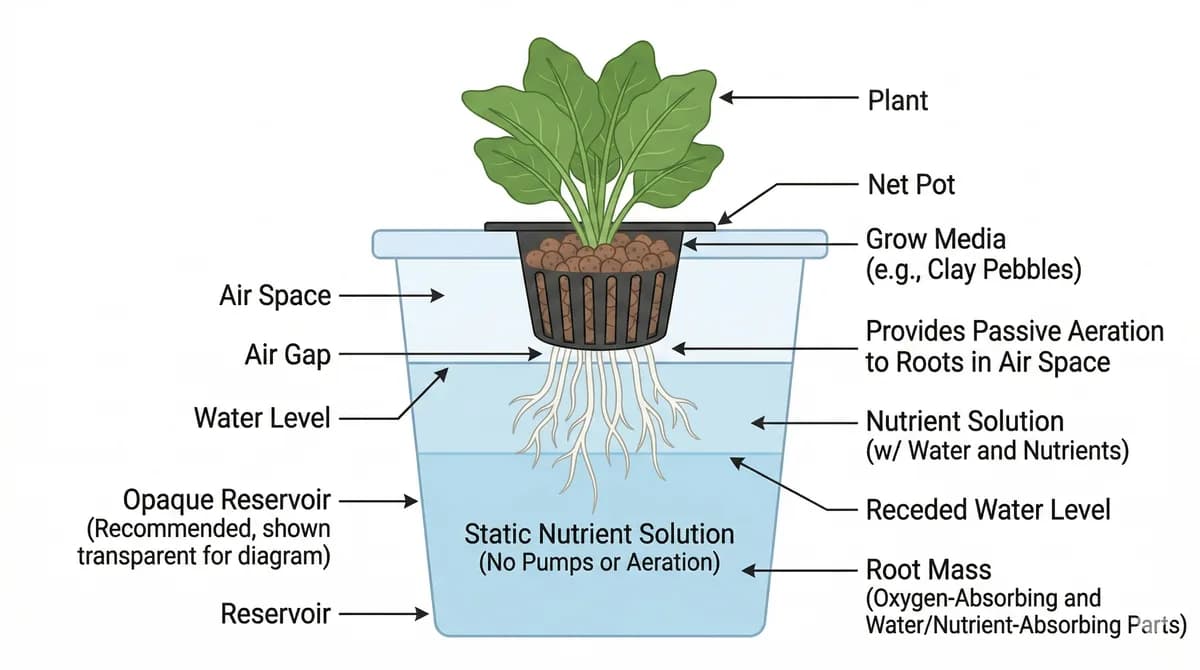
Best for: Lettuce, herbs, microgreens
A passive, no-pump variant of DWC. The plant starts with roots just touching the solution; as it drinks, an air gap forms naturally providing oxygen. No electricity required. Add solution as needed.
Pros
Cons
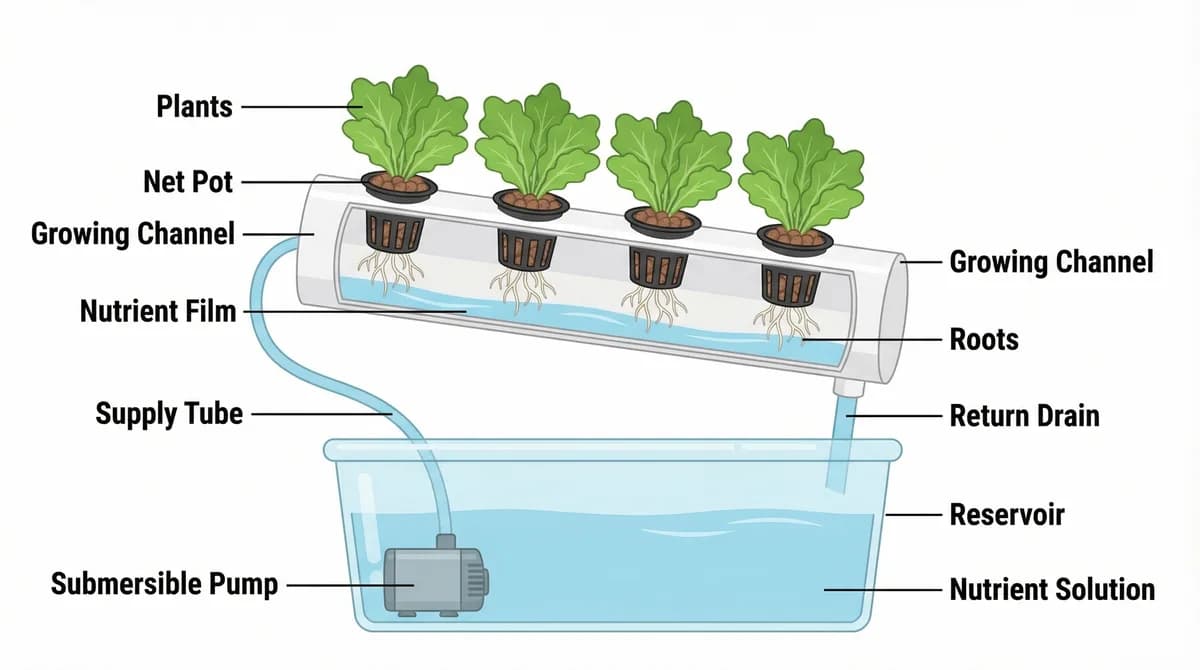
Best for: Lettuce, spinach, herbs at scale
A thin film of nutrient solution flows continuously along slightly sloped channels. Roots hang inside the channel, the upper portion in air, the lower tips in the film. Excellent oxygen exposure and very low water usage.
Pros
Cons
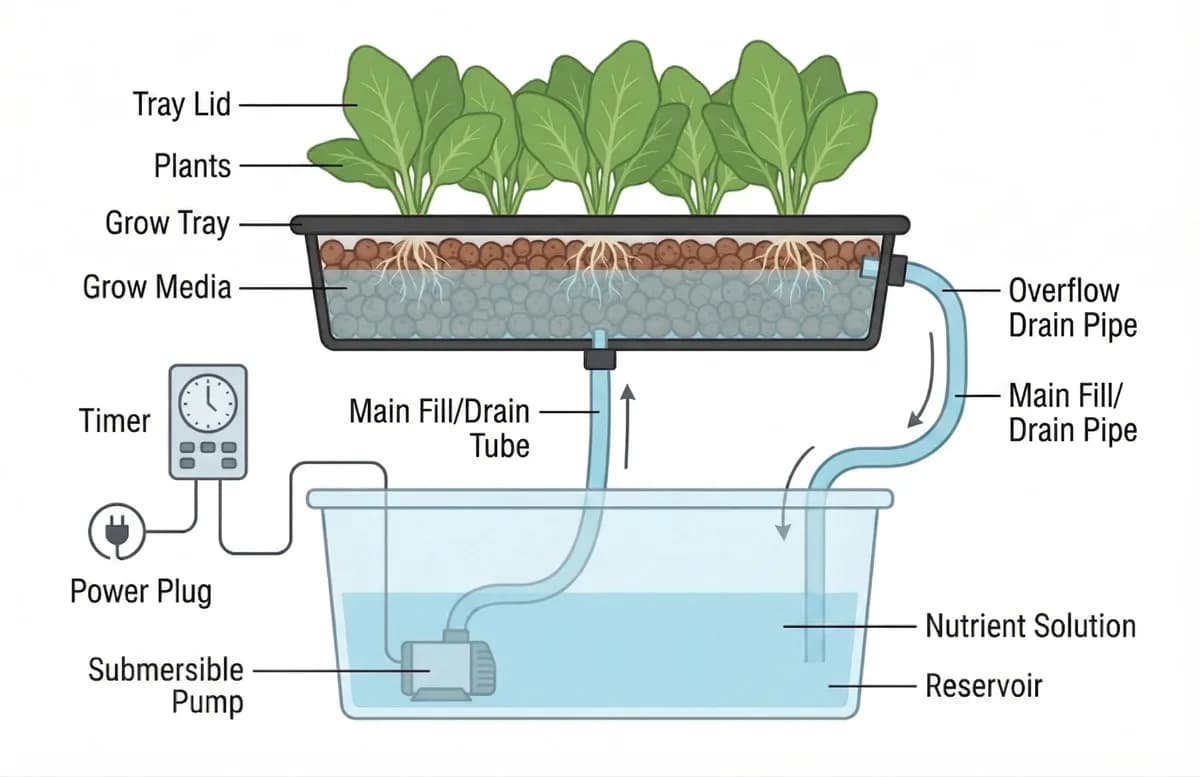
Best for: Most crops including fruiting vegetables
A tray is periodically flooded with nutrient solution via a pump on a timer, then allowed to drain back to the reservoir. The cycle of wet and dry provides both hydration and oxygen. Very versatile — works with almost any media and most plant types.
Pros
Cons
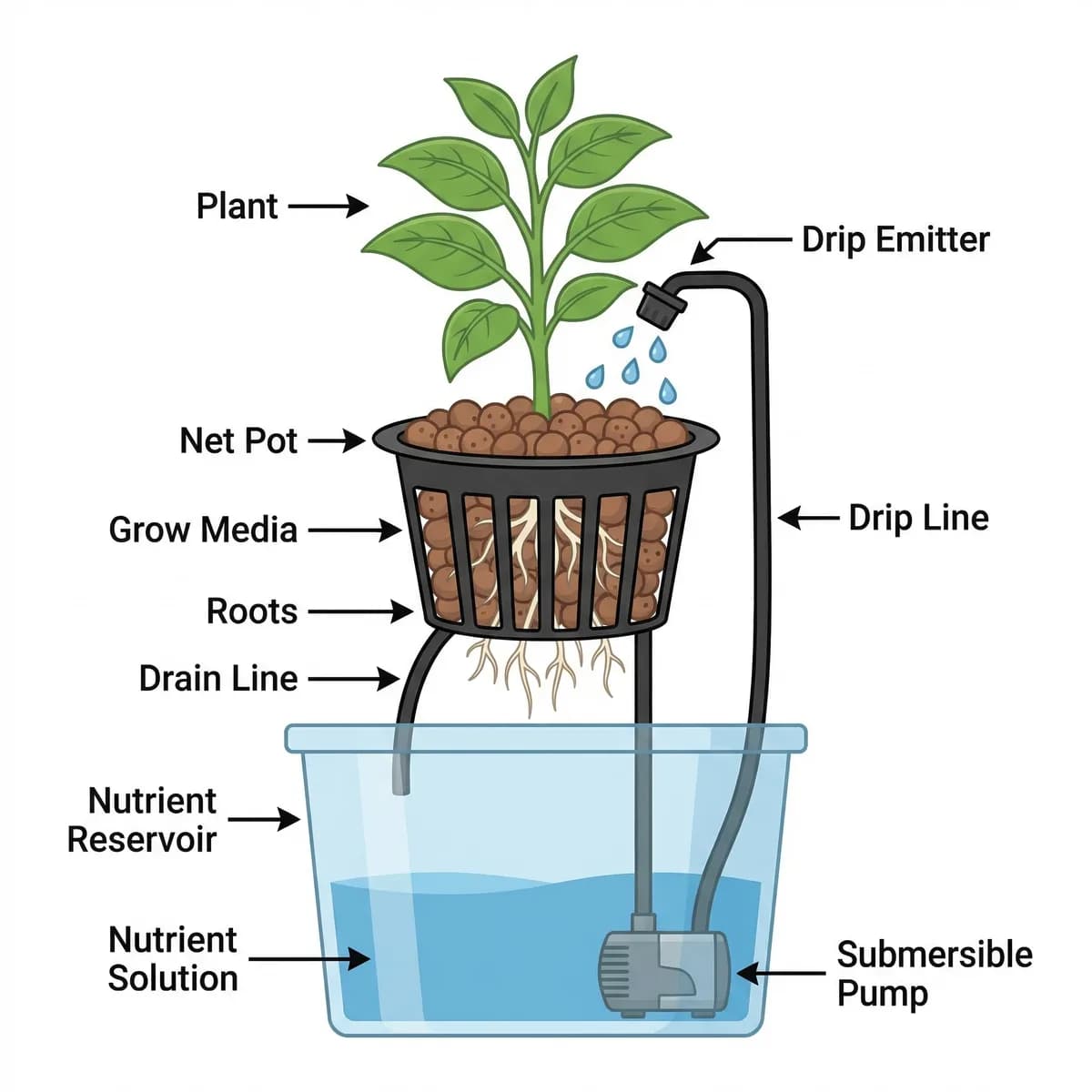
Best for: Tomatoes, peppers, cucumbers, strawberries
Nutrient solution is pumped from a reservoir and dripped slowly onto the base of each plant via individual emitters on a timer. The most widely used system in commercial greenhouse production worldwide.
Pros
Cons
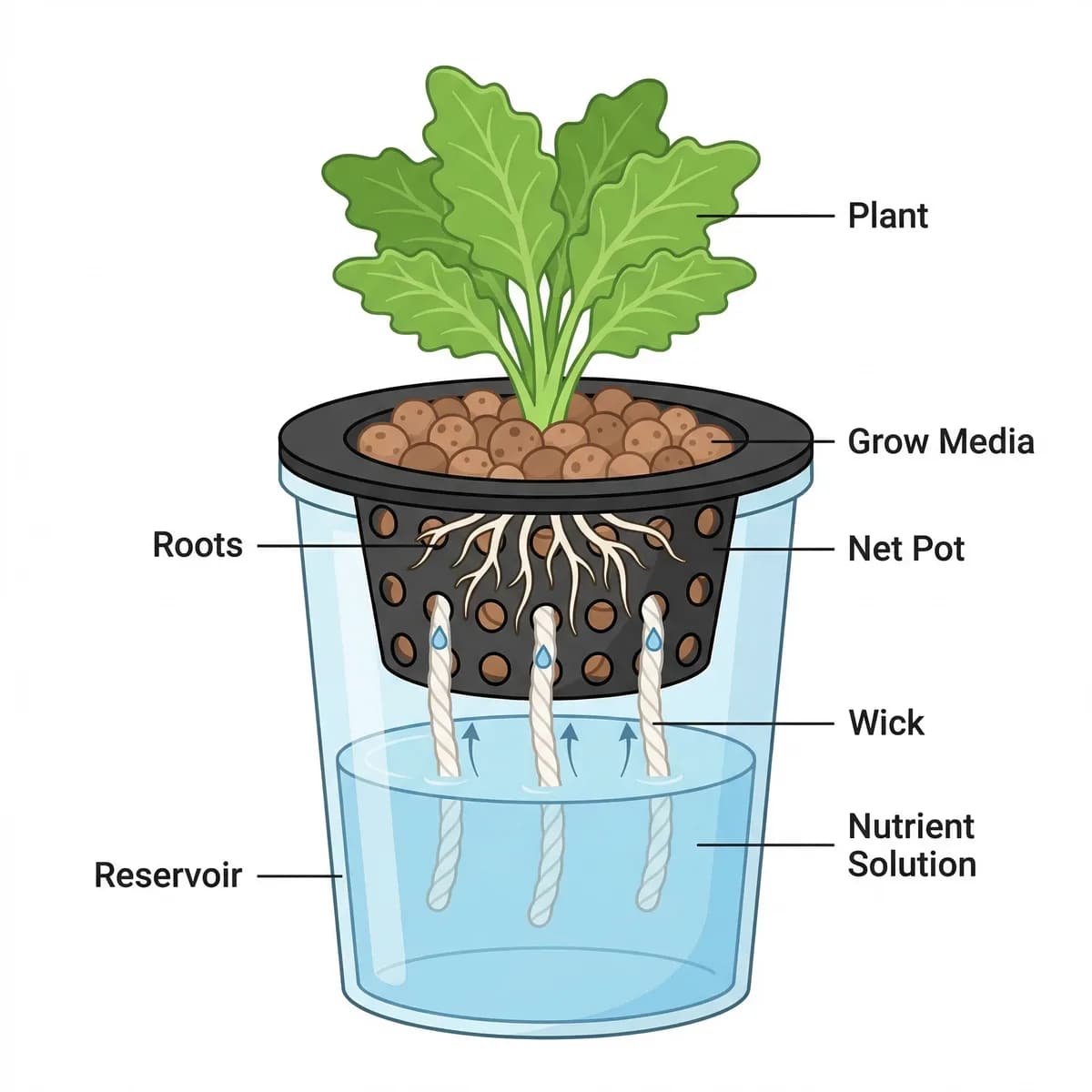
Best for: Small herbs, microgreens
The simplest possible hydroponic system. Absorbent wicks draw nutrient solution from a reservoir into the growing medium by capillary action. No pump, no timer, no electricity. Suitable only for small, low-demand plants.
Pros
Cons
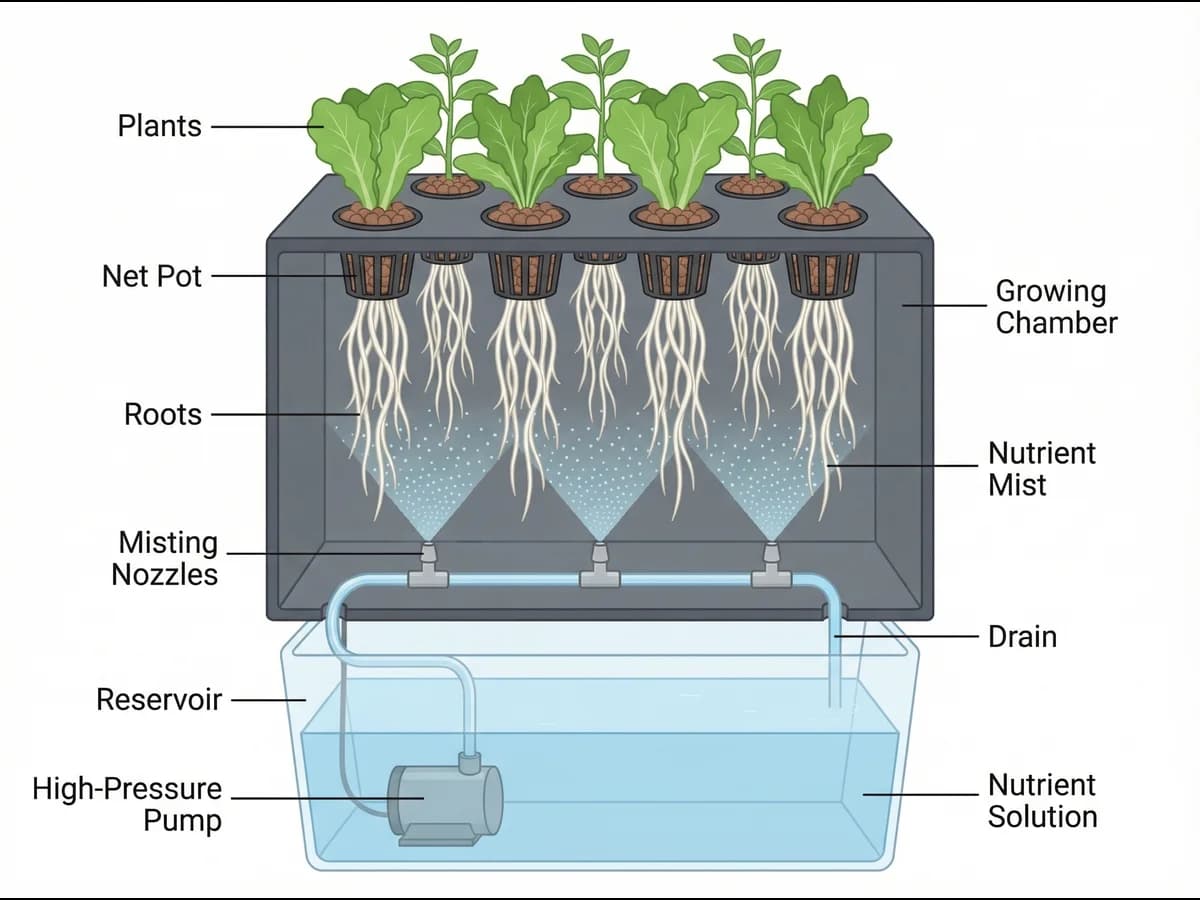
Best for: Fast propagation, cloning, research grows
Roots are suspended in air inside a chamber and misted with nutrient solution every few minutes by high-pressure nozzles. Exceptional oxygen exposure drives very fast root and plant development. Widely used in commercial cloning and R&D.
Pros
Cons
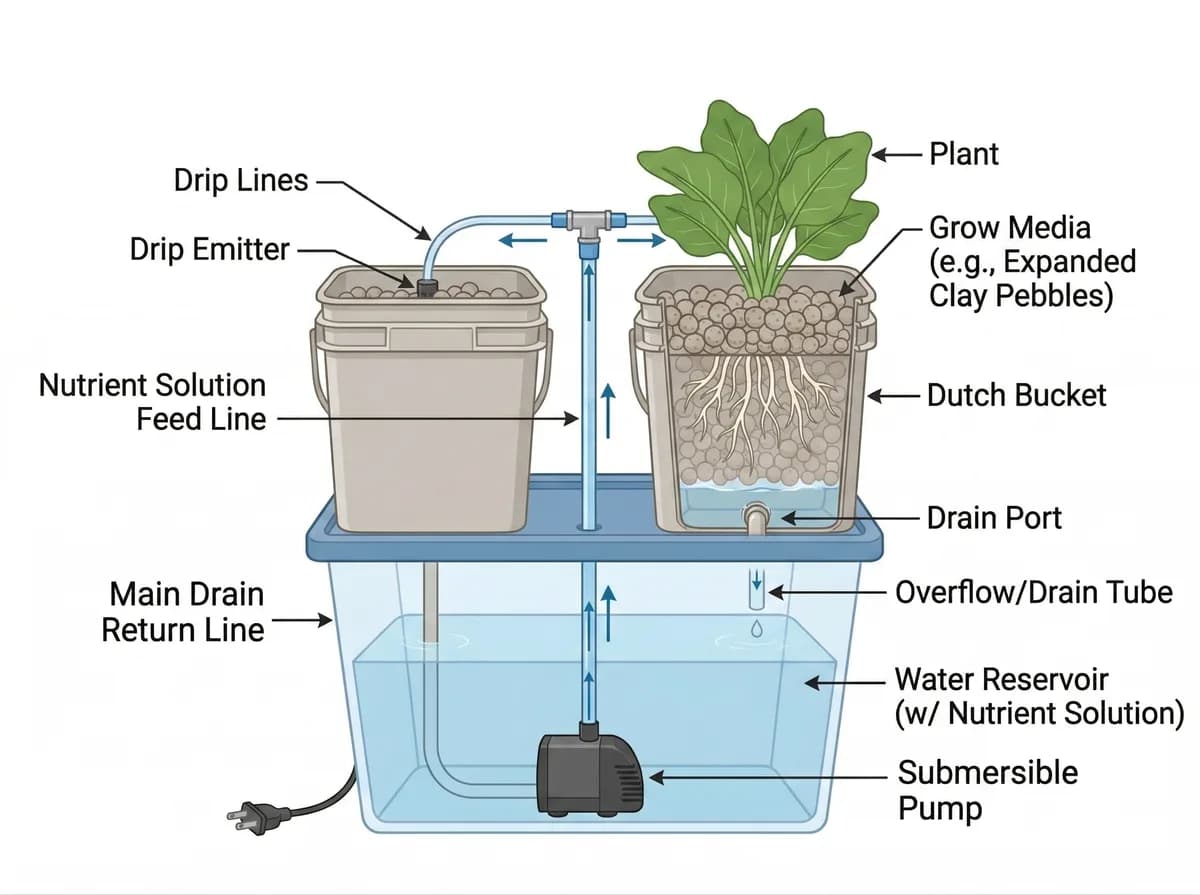
Best for: Tomatoes, cucumbers, peppers, aubergines
Each plant grows in its own bucket filled with perlite, coco, or clay pebbles, fed by a drip emitter. All buckets share a common drain line back to the reservoir. The standard for large fruiting crops in commercial greenhouses.
Pros
Cons
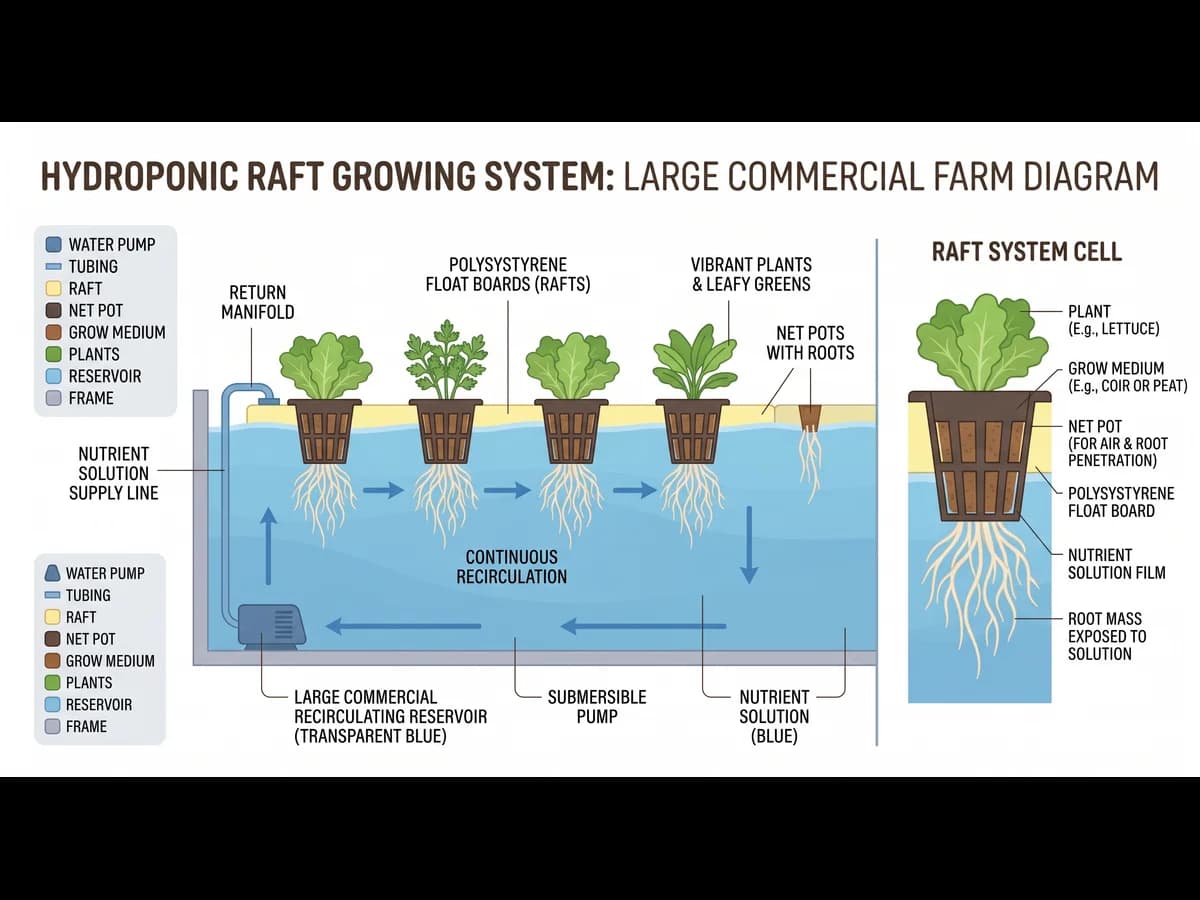
Best for: Lettuce, leafy greens at scale
Floating polystyrene or foam boards with net pot holes sit directly on the surface of a large, shallow reservoir of oxygenated nutrient solution. The commercial standard for high-volume lettuce and leafy green production. A single 1.2 m × 2.4 m raft can hold 50–100 heads of lettuce simultaneously.
Pros
Cons
Space-Efficient Growing
Drip towers, aeroponic towers, stacked NFT racks, and pocket wall panels let you grow upward rather than outward — fitting 20–40 plants into the footprint of a single pot. Lighting management is the key challenge; our dedicated guide covers all five vertical formats with full pros, cons, crop suitability, and lighting solutions.
Decision Helper
| Your situation | Recommended | Why |
|---|---|---|
| Complete beginner, want something simple | Kratky | No pump, no timer, no plumbing — just water and nutrients in a jar. |
| Beginner, want faster growth with active system | DWC | Simple plumbing, excellent results, easy to understand and troubleshoot. |
| Growing mostly leafy greens and herbs | NFT or DWC | Both are efficient and purpose-built for low-maintenance leaf crops. |
| Want to grow tomatoes or cucumbers | Dutch Bucket | Individual containers, proper drip feed, handles large indeterminate plants well. |
| Limited space, multiple plant sites | NFT or vertical DWC | NFT channels stack or run horizontally without wasted space. |
| Off-grid or no power access | Kratky or Wick | Both are fully passive — no electricity needed. |
| Propagating clones commercially | Aeroponics | Fastest root development, best success rate for cuttings. |
| Want a flexible system for mixed crops | Ebb & Flood | Works with almost any media and most plant types — the most versatile option. |
| Limited floor space, want more plant sites | Drip Tower | One tower can hold 20–32 plants in under 0.5 m² of floor space. Simple pump, beginner-friendly. |
| High-density lettuce production | Raft DWC | Float-bed systems hold 50–100 heads per 1.2×2.4 m raft. The commercial standard for leafy greens. |
| Maximum yield from a vertical format | Aeroponic Tower | 20–30% faster growth than drip towers. Requires high-pressure pump but delivers best results at scale. |
Best Practices
Clean your reservoir and system components at least every 2–3 weeks to prevent algae growth and salt buildup, which can clog pumps and damage roots.
If using an active system, verify each day that your pumps are running and water is flowing correctly. A failed pump can destroy a crop within hours.
Keep your nutrient solution between 18–22°C (65–72°F). Higher temperatures reduce dissolved oxygen and dramatically increase the risk of root rot.
Master DWC or Kratky before progressing to NFT or Aeroponics. The fundamentals you build — pH management, nutrient mixing, root health — transfer directly to any system.
Start simple. Master one system before adding complexity. The best hydroponic growers are not those with the most advanced systems — they are those who understand their chosen system thoroughly. A Kratky jar grown with real attention will outperform a poorly managed aeroponic system every time.
Choose one system, run it for a full grow cycle, and take notes. The next grow will be significantly better.
FAQ
Next Steps
Ready to set up your grow? Open the System Builder → for a checklist of what you need, indicative prices, and links to find everything.